The €250 "solid 14K gold" ring on your screen right now
Open Etsy. Open Temu. Open Amazon. Search for "solid 14K gold ring." Within thirty seconds you will find a piece advertised as "real solid gold," "handmade," "high quality," "14K stamped" for €190, €250, €380, €600. Five-star reviews. Cute photos. Maybe even a "limited stock" timer.
Here's the truth, dearies, and we say this as the people who literally make this stuff for a living: that ring is not solid gold. It cannot be. The math doesn't work. The law it's being shipped under doesn't care if you know that. And the platform selling it to you is not authenticating any of it.
This is one of the biggest, quietest scams happening in the jewelry world right now. And the good news for anyone reading this from the Netherlands or the EU is that the law in your country is already on your side. You just need to know how it works.
This blog is the full breakdown. Why Dutch and EU rules genuinely protect you, why US online marketplaces (especially Etsy) are structurally a minefield, the math that proves cheap "gold" is impossible, what buying from an actual Dutch goldsmith really looks like, and (most importantly if you're shopping for them) the specific extra warnings for wedding rings, where every problem in this blog gets dramatically worse.
Pour something. Let's go.
The math that ends the conversation in one paragraph
Before we get into law and platforms, let's do the only piece of arithmetic you'll need to spot 95% of fake gold online.
As of late May 2026, the global gold spot price is sitting around €4,000+ per troy ounce (a troy ounce is 31.1 grams). That works out to roughly €127 per gram of pure 24K gold. We covered the full price story in our blog "Why Gold Got So Expensive in 2026" in the Story Realm.
14K gold is 58.5% pure gold alloyed with other metals. At our atelier, our finished material cost for 14K yellow gold is roughly €86 per gram. That's our actual wholesale price for clean, hallmark-ready 14K alloy. Add to that: design hours, casting, hand-finishing, stone setting, hallmarking fees, packaging, and the small detail of two human beings being able to eat.
So let's run a quick test on that "€25 solid 14K gold ring" you're looking at.
A reasonable solid 14K ring weighs roughly 3 to 6 grams. At €86 per gram of 14K alloy, the material cost alone is between €258 and €516. Before anyone has even picked up a tool. Before any labor, any hallmark, any shipping, any platform fees.
A real, hand-made solid 14K ring cannot cost €250. It cannot cost €600. It cannot cost €120. Anyone selling something at that price as "solid 14K" is either lying about the metal, lying about the weight, or lying about both.
If the math doesn't math, the gold isn't gold.
Write that down. It's the whole blog in one sentence.
What's actually being sold to you when the price is too low
Three possibilities, in order of how often we see them.
1. Gold-plated.
A base metal (usually brass, copper, or some zinc alloy) with a thin gold film electroplated on top, often 0.175 to 0.5 microns thick. That film wears off in weeks to months. Once it does, the base metal corrodes from contact with your sweat and skin oils, sometimes turning your finger green, sometimes giving you a nickel rash. We did the full breakdown in our blog "Solid Gold vs Gold Plated, Gold Filled, Vermeil and Doublé" with the actual Dutch and EU law and the electroplating science.
2. Gold-coloured.
Just base metal with a yellow-tinted finish. No gold at all. PVD or IP coatings. Looks gold for about a week.
3. Stainless steel "18K gold."
This one is sneaky. Listings advertise "stainless steel 18K gold ring." Stainless steel and gold are completely different metals. What you're actually buying is stainless steel with a microscopic gold-coloured coating. The "18K" refers to the color of the coating, not the metal of the piece.
In all three cases, the seller benefits from a critical fact: under the strict letter of Dutch and EU law, none of these are legally gold. But if they're shipped from outside the EU and listed on a platform that isn't auditing metal content, you can be sold them as "gold" anyway. Until you receive it, scratch it on a stone, and watch the disappointment happen in real time.
Why this happens so much on Etsy (and Amazon, and Temu, and Shein, and AliExpress)
We want to be fair here. There are genuine, brilliant, honest small makers on Etsy and we'd never trash them as a group. We've been small handmade sellers ourselves. We know how hard that grind is.
But the platform itself has a known, documented, structural problem. Here is what's actually on record.
The fake-handmade dropshipping problem. Etsy is meant to be a marketplace for handmade and vintage items. In practice, an enormous percentage of jewelry listings are dropshipped from mass manufacturers in China, repackaged and sold as "handmade" by sellers who have never touched the item. One investigation found a single Etsy store had sold close to 40,000 pieces of jewelry listed as "self-made" or vintage, when in fact those items were mass-produced and available on AliExpress at a fraction of the price.¹ This isn't a one-off. There are entire subreddits, TikTok accounts, and watchdog Twitter accounts dedicated to tracking it.
The 5% figure. A Wedbush Securities financial analysis, cited in an investor class action filed against Etsy, found that more than 5% of Etsy's offerings are fake or violate copyright and trademark regulations.² That's millions of listings.
The reviews-can-be-faked problem. Buyers' main defense on these platforms is reading reviews. But cheap "gold" sellers routinely run bot or paid-review clusters: many five-star reviews posted in tight time windows using similar repetitive language. Independent shopping safety analyses warn buyers to look for these patterns and to filter for 1-star reviews instead of trusting the average rating.³ One TikTok creator documented buying a "14K solid gold bangle with five real diamonds" from a "reputable" Etsy seller with thousands of 5-star reviews. One of the diamonds was a fake. She only found out months later when an independent jeweler examined it.⁴
No platform-level metal authentication. Etsy, Amazon, Temu, Shein, and AliExpress do not test the gold content of the jewelry listed on their sites. They don't run independent assays. They don't verify hallmarks. If a seller writes "14K solid gold" in their listing, the platform takes that at face value. There is no equivalent of the Dutch Waarborg system on these platforms. Authentication is on the buyer, after the package arrives.
Which means: when something goes wrong, you don't have law on your side. You have a refund process. And if you don't get the piece independently appraised, you may not even know you've been scammed.
Now compare that to buying gold in the Netherlands
This is the part most Dutch consumers don't realize they have. The Dutch hallmarking system is one of the strictest in the world, and it exists specifically so consumers don't have to be their own forensic gold experts. Read more in this blog.
The Waarborgwet 2019
The current Dutch hallmarking law is the Waarborgwet 2019, which came into force on 1 July 2020 and replaced the older Waarborgwet 1986.⁵ Its entire purpose is to make sure that when a piece in the Netherlands is sold as "goud," it is actually goud, at the fineness claimed.
Key things the law mandates:
- Article 33 of the Waarborgwet 2019 legally protects the words "edelmetaal," "platina," "goud," and "zilver". You may only sell something as gold if it meets the legal definition.⁶
- Minimum legal fineness to be sold as "goud" in the Netherlands is 585/1000 (14 karat). Anything below that cannot be called gold here, even if it contains some gold.⁷
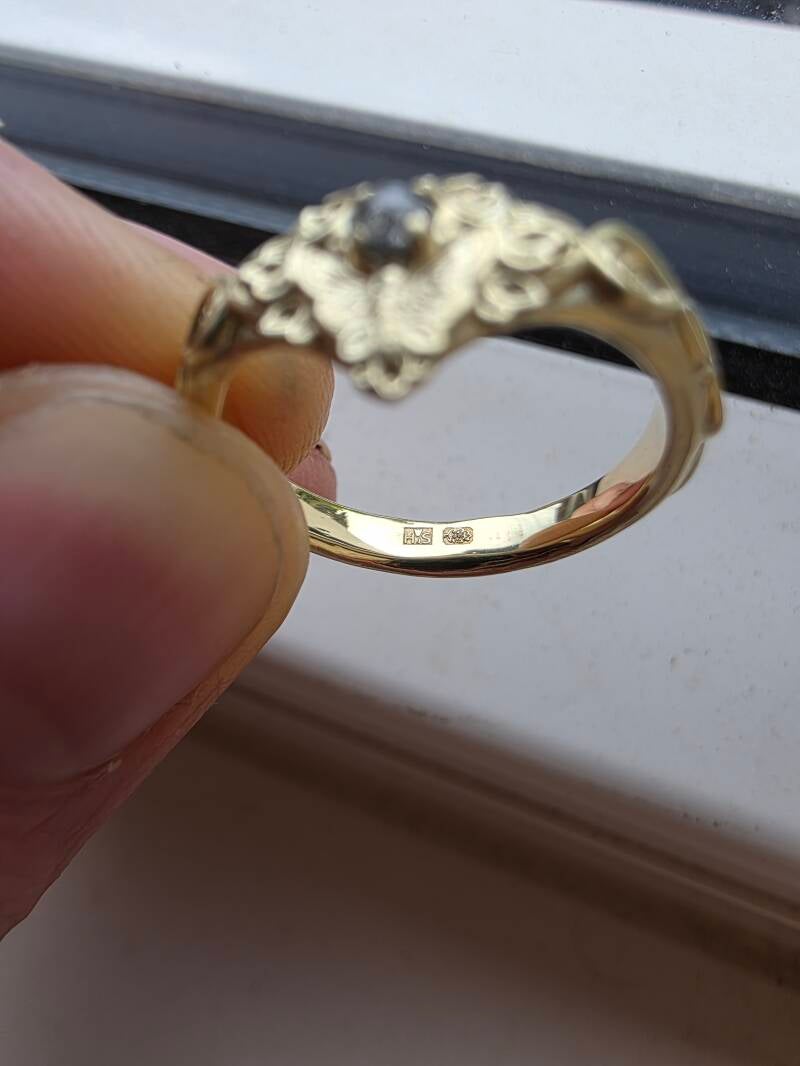
- Every gold piece weighing more than 1 gram must carry an official hallmark from one of the two appointed Dutch assay offices: WaarborgHolland or Edelmetaal Waarborg Nederland (EWN).⁷ For silver the threshold is 8 grams. For platinum it's 0.5 gram.
- Both assay offices are accredited under ISO/IEC 17020 (inspection bodies) and ISO/IEC 17025 (testing laboratories).⁸ Their tests are independent of the goldsmith. We send our finished work to them. They verify, then stamp.
- Any surface gold coating thinner than 50 micrometers is legally NOT gold under the Waarborgwet 2019. Gold-plated, gold-filled, vermeil, doublé, PVD, RGP, HGE: all the same category under Dutch law. None of them get a hallmark. None of them can be sold as "goud."⁶
Enforcement is real and unannounced
The law is enforced by the Rijksinspectie Digitale Infrastructuur (RDI), the Dutch government inspectorate under the Ministry of Economic Affairs (formerly Agentschap Telecom, renamed 1 January 2023).⁹ RDI inspectors visit jewelers, wholesalers, market stalls, and even online sellers based in the Netherlands without warning. They check that every piece sold as gold above 1 gram is properly hallmarked. If a seller is in breach, they face real legal consequences. You as a consumer can also report a suspected violation to the RDI directly.⁹ We have known goldsmiths that were faced by these concequences. They are fierce. Most goldsmiths can close up shop when they bring a visit and the hallmarking was not done right.
EU-wide context
The Netherlands is a signatory to the Convention on the Control and Marking of Articles of Precious Metals (Hallmarking Convention, Vienna 1972), which means Dutch hallmarks are recognized in 20+ other contracting states across Europe, and vice versa.¹⁰ Most EU member states have their own national hallmarking laws that work similarly to the Dutch system. So buying from a registered EU goldsmith means you're inside this protective framework.
The EU also enforces REACH Regulation (EC) No 1907/2006, Annex XVII, Entry 27, which strictly limits nickel migration from jewelry intended for direct and prolonged skin contact (less than 0.5 µg/cm²/week, and less than 0.2 µg/cm²/week for piercings).¹¹ The official test method is EN 1811:2023. This is why your skin doesn't itch when you wear properly EU-made jewelry, and why cheap dropshipped jewelry from outside the EU is so often a nickel allergy risk.
The contrast: how US marketing terms get loose
This is the part that catches a lot of EU buyers out when they buy from American sellers. US gold law exists, but it's structured differently and the bar is significantly lower.
The US Federal Trade Commission, 16 CFR Part 23, the Guides for the Jewelry, Precious Metals, and Pewter Industries sets the US standards.¹² Some of the actual numbers:
- Vermeil: minimum 2.5 micrometers of at least 10K gold electroplated over sterling silver. (Dutch threshold for an assayed gold surface layer: 50 micrometers. That's 20 times stricter.)
- Gold filled: minimum 1/20th (5%) by weight of the gold layer mechanically bonded to a base metal core. (Still a coating under Dutch law; cannot be sold as gold here.)
- Gold plate, gold electroplate, rolled gold plate: much thinner layers, with disclosure requirements but no minimum thickness threshold for the term "gold plated."
On top of that, US online marketplaces are full of marketing terms that aren't legally regulated in the same way. "Gold-toned," "gold-finish," "gold-look," "high-quality gold," "gold-style," "fashion gold." None of these are equivalent to actual solid gold in EU law. Some of them have no precise definition at all. They exist to make a non-gold object sound gold-adjacent.
Compared to the Dutch system where a state inspectorate physically tests the metal before it can be sold as gold, the US framework essentially asks the buyer to be their own expert. That works fine if you know the FTC rules cold. It works terribly if you don't.
So when you buy from a US Etsy seller and the listing says "14K gold-filled," you're not getting solid 14K gold. You're getting a thin layer of 10K-or-higher gold over a base metal. Under Dutch law that piece can't be sold as "goud" at all.
What you actually get when you buy from a real Dutch goldsmith
Now the part that matters. Here's the difference, in practical terms, between clicking "add to basket" on an anonymous Etsy listing and commissioning a piece from a goldsmith in the Netherlands.
1. The metal is verified by the state.
Every gold piece over 1 gram has been independently tested and hallmarked by WaarborgHolland or EWN. You don't have to take anyone's word for it. The mark inside the ring is the state's word.
2. You can see the maker's actual face.
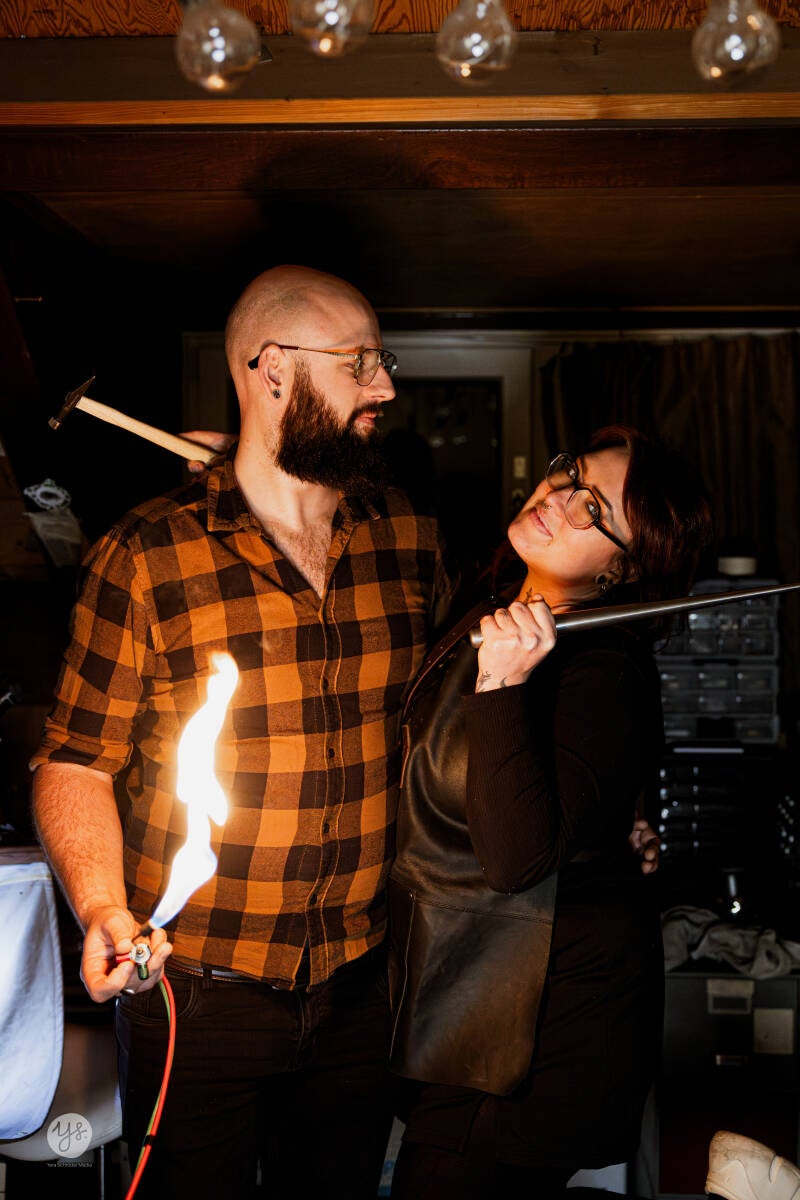
A real Dutch goldsmith has a name, a workshop address, a sponsor's mark registered with WaarborgHolland or EWN, and a real online presence with process content showing the work being made. (You can see ours all over our Instagram. Our two cats are usually in the shot.)
3. The piece is built to be serviced for life.
We covered this in detail in our blog "Why Gold Is Worth It". Solid gold can be resized, mended, polished, and recast forever. A plated piece from an Etsy dropshipper cannot. When it wears, it's done.
4. If you have old gold, it can become your new gold.
Our "Recasting Gold" blog explains how we melt down gold you already own and turn it into a new creation. This is impossible with plated jewelry, and it's a legitimately smart way to get into solid gold when prices are this high.
5. You're inside EU consumer protection law.
Distance selling rights, the EU 2-year statutory warranty (Consumer Rights Directive 2011/83/EU), REACH safety for skin contact. None of that is reliably enforceable against an unverified seller shipping from outside the EU.
6. The math actually works.
We can tell you exactly what your piece costs, broken down: grams of gold at the day's gold price, gemstone cost, design hours, casting, finishing, hallmarking. No mystery. No miracle pricing. Because there are no miracles in metallurgy. There's just metal, time, and skill.
Red flags for online gold jewelry (save this list)
If you do shop online, here's a quick checklist of warning signs. If a listing or seller checks two or more of these, walk away.
- Price suspiciously low for solid gold. A €250 ring listed as "solid 14K" is, mathematically, impossible.
- No goldsmith's name or face on the seller's About page. No process photos. No workshop.
- "Stainless steel 14K gold" or similar combinations of two different metals. These are coatings, not solid gold.
- "Gold-toned," "gold-style," "gold-look," "fashion gold," or any term that softens the word "gold." Real gold sellers don't soften the word. They say 14K solid gold and they prove it.
- Reviews clustered in tight time windows with repetitive language. Possible bot or paid reviews.
- Reverse image search of the product photo brings up the same image on AliExpress, Temu, or another wholesaler. Dropshipping red flag.
- Shipping from China when the listing claims "handmade in [European country]." Self-explanatory.
- No transparent breakdown of weight and karat. A real goldsmith will tell you exactly how many grams of 14K or 18K are in the piece.
- No mention of an assay office or hallmark for EU sellers. EU goldsmiths working in solid gold above 1 gram must hallmark. If they're not talking about it, ask why.
- Vague country of origin or company info. No physical address. No KvK (Chamber of Commerce) number for Dutch sellers. No verifiable business identity.
If a seller passes all of these and you still want a second opinion, take the piece to any registered Dutch goldsmith or to one of the assay offices directly. They can verify in minutes.
Wedding rings deserve their own warning (this is the absolute worst place to get scammed)
If everything we said above made you cautious, then please read this section twice if you're shopping for wedding rings. Because every single weakness in cheap online "gold" gets dramatically worse when the piece is going to live on your hand for the next 50+ years.
Wedding rings are a goldsmith's hardest, most precise, most accountable work. They're also, sadly, one of the most aggressively scammed categories online. We've seen couples come to us heartbroken because the matching €1200 "14K solid gold" wedding rings they bought from an Instagram ad failed within their first year of marriage. Two rings turned greenish. One broke. One was unresizable. They started their marriage with a small piece of forever, and twelve months later they had nothing to show for it. We do not want that for you.
Here's everything to watch out for.
The wedding ring math is even more brutal
A typical solid 14K wedding band weighs 4 to 8 grams depending on width and profile. At our atelier's material cost of €86 per gram of finished 14K gold, the metal in a single plain band is €344 to €688 before any work has happened. A pair of matching solid 14K bands is therefore €688 to €1,376 in raw metal alone, before design, casting, hand-finishing, engraving, sizing, hallmarking, polishing, and shipping.
So when you see a listing advertising "his and hers 14K solid gold wedding rings, €990 the pair, free engraving", the math is telling you, in screaming capital letters, that those rings are not gold. They cannot be. The seller is either lying about the karat, lying about the weight, lying about the alloy, or lying about all three.
If the math doesn't math, the gold isn't gold. This rule is the most important on your wedding ring purchase of any in your life.
The matching set trap
This is one we see constantly. A couple orders two "matching" gold rings from an online seller. The rings ship from two different production batches, possibly from two different factories, possibly months apart. They arrive looking almost the same color but not quite. One is slightly more yellow. One is slightly more rose. In daylight you notice. In photographs you notice. In your wedding photos you notice forever.
This happens because cheap "gold" jewelry isn't cast from a single controlled alloy melt. It's mass-produced from whatever wholesale supply was available that week. Color consistency is not a priority. Two rings from the same "matching set" listing can come from completely different physical pieces of metal.
A real goldsmith making a wedding ring set casts both rings from the same controlled alloy batch. They're metallurgically siblings. Same exact shade, same exact metal, by deliberate design.
The "free engraving" promise (especially on plated rings)
Wedding rings traditionally carry an engraving. Names. A date. A short line. Many online sellers offer this engraving for free as part of the listing.
Here's the catch. On a plated or coated ring, the engraving is usually applied by laser to the surface. The surface, as you now know, is a thin film of gold-coloured material on top of a base metal. As the plating wears at the high-contact points of daily wear (and your ring lives at one of the highest-friction points of your entire life, your hand), the engraving wears with it. You can lose your wedding date in 18 months.
On a solid gold ring, engraving is cut into the gold itself. By hand, with proper hand engraving, or with a controlled engraving machine. Done well, it survives polishing, resizing, and decades. It can even be re-cut later if it ever softens from being polished too many times. We covered hand engraving as one of Huib's specialties on our Instagram if you want to see what it actually looks like up close.
The stone problem (diamonds, "diamonds," and outright glass)
If your wedding or engagement ring has a centre stone, the scam surface area doubles. Common online deceptions:
- Cubic zirconia (CZ) sold as diamond. Cheap, sparkles, but completely different material. Looks fine for a year, then dulls.
- Moissanite sold as diamond. Moissanite is a real gemstone with its own value, but it is not diamond. Some sellers blur this on purpose.
- Lab-grown diamonds sold as natural diamonds. Lab-grown diamonds are real diamonds, optically and chemically. But they cost significantly less than mined diamonds. Sellers sometimes label lab-grown as natural to charge natural prices, which is fraud.
- Glass. It happens. Especially on the cheaper end.
- A "diamond" that's actually graded by a fake or unrecognised laboratory. GIA, IGI, HRD are the major reputable labs. Anything else, treat with skepticism and re-test independently.
We covered some of this in our earlier blog about the Etsy seller who sold a "14K gold bangle with five real graded diamonds." One of the five was a fake. The buyer only discovered it months later via an independent appraisal. On a wedding ring, that kind of surprise lasts forever.
A Dutch goldsmith working in solid gold with real stones will tell you exactly what stone you're getting: natural or lab-grown, what grading lab (if any), and the precise carat weight and 4Cs of any diamond. In writing. With certificates if you want them.

The sizing nightmare you didn't know you'd have
Here's something nobody tells you when you're 28 and getting married: your finger is going to change. It will change in summer when it's hot. It will change in winter when it's cold. It will change if you become pregnant. It will change as you age. It will change if you go through a stressful year. Your wedding ring needs to be resizable.
Plated wedding rings cannot be resized cleanly
Resizing requires cutting the ring, removing or adding metal, and soldering it closed. On plated jewelry, soldering destroys the plating around the joint and exposes the base metal. The repair is visible. The ring is permanently compromised.
Gold-filled and doublé wedding rings can technically be resized
but the seam where you resize will look different from the rest of the band because you're soldering through the gold layer into the base metal. Again, visible repair.
Solid gold wedding rings resize beautifully,
again and again, over decades. Because gold is the most ductile metal and is noble (so it doesn't oxidise during soldering), the resize joint disappears cleanly into the band. We covered the metallurgy of this in our blog "Why Gold Is Worth It".
If your wedding ring needs to fit for 50+ years, it must be solid gold. There is no other answer.
Bonus angle: recasting old family gold into your wedding rings
his is one of our favourite quiet things to offer, and it's specifically magical for wedding rings.
If either of you has gold from your family (a grandparent's wedding band, an inherited piece you'll never wear, a ring from a previous chapter you've made peace with), we can melt that gold down and recast it into your new wedding rings. The same atoms that were part of your grandmother's marriage become part of yours. It's the kind of continuity that nothing money can buy you off Etsy can ever offer.
The full process is in our "Recasting Gold" blog. Couples genuinely cry when they pick up their rings. Just so you know what you're signing up for.
What to look for in a Dutch wedding ring goldsmith
If you decide you want to do this properly, here is your checklist:
- Verified Dutch business identity (KvK Chamber of Commerce number visible on website, real address)
- A sponsor's mark registered with WaarborgHolland or EWN (we have one, every legitimate Dutch goldsmith has one)
- Solid 14K or 18K only, with proper hallmarks promised on every piece above 1g
- In-house casting from a single controlled alloy melt for matching ring sets
- Hand engraving option, not just laser-on-plating
- Real diamonds with optional GIA/IGI/HRD certification
- Made-to-order with every ring size available, and a written commitment to resize cleanly for life (gold makes this easy; we covered the metallurgy)
- A real maker's face and process content, not stock photos
- Optional recasting of your own old gold if you want to bring the past into the future
This is what a "wedding ring goldsmith" actually means. Not a website that pretends.
Only the real stuff. Two materials, both solid, both honest, both verified.
- Solid 14K gold (18K on request) for our Heirloom Vault Collection, our Fine & Precious creations. Handmade by the two of us in our atelier with precious gemstones, diamonds, and gold inlay. Every gold piece above 1 gram goes through WaarborgHolland or EWN for proper Dutch hallmarking. Browse the Heirloom Vault here: atelierwolfstone.com/jewelry-realm/the-heirloom-vault-collection.
- Sterling silver (925) for everything else, openly and proudly. Silver is not a "lesser" version of gold to us. It's a beautiful metal in its own right with its own honest place. We hallmark every silver creation above 8 grams.
Our Custom Realm is open by appointment for one-of-a-kind creations.
If gold prices are putting solid gold out of reach right now, read our "Recasting Gold" blog about using gold you already own. And if you're curious about why gold is worth this in the first place, our "Why Gold Is Worth It" blog has all the metallurgy and history.
-
One of a Kind

-
Made to Order
 The Cathedral Window Pendant | 14K gold | Made to Order | Regina €850.00 FREE shipping
 -
Made to Order
 The Drama Queen Ring | 14K Gold | Made to Order | personisable gemstone | Regina €1,750.00 FREE shipping
 -
One of A Kind
 The Drama Queen Ring | 14K Gold | size 17 | Ready to Send | Green Diamond | Regina €2,050.00 FREE shipping
 -
Made to Order
 Villain Era Rings | 14K Gold | Made to Order | Size Inclusive | Regina €995.00 FREE shipping
Quick answers (the thing you probably googled for)
Is gold jewelry on Etsy real gold?
Sometimes yes, often no. Etsy does not test or authenticate metal content on listings. A Wedbush Securities analysis cited in investor litigation found that more than 5% of Etsy offerings are fake or violate copyright and trademark regulations, and journalism and watchdog accounts have repeatedly exposed sellers dropshipping mass-produced "gold" jewelry as handmade. Always run the price math (real solid 14K cannot cost €250) and look for an actual hallmark.¹⁻²
How do I know if a gold ring is real?
In the Netherlands and EU, look for an official hallmark stamp inside the ring: a karat number (585 for 14K, 750 for 18K) plus the stamp of an authorized assay office (WaarborgHolland or EWN in the Netherlands). Any gold piece sold above 1 gram in the Netherlands must legally carry this hallmark.⁷
Why is gold jewelry on Temu, Shein, AliExpress, and Amazon so cheap?
Because it isn't gold. At late-May 2026 gold prices, the metal alone in a real 5-gram solid 14K piece costs hundreds of euros. Listings at €10-€60 are gold-plated, gold-coloured, or stainless steel with a thin gold coating. Under Dutch and EU law, none of these can legally be sold as "gold."⁶
Is it safer to buy gold jewelry from a Dutch goldsmith than online?
Yes, significantly. Dutch goldsmiths are required by the Waarborgwet 2019 to hallmark every gold piece over 1 gram through an independent state-authorized assay office. The Rijksinspectie Digitale Infrastructuur (RDI) actively enforces this with unannounced inspections. You're inside EU consumer protection law and REACH nickel-safety rules.⁵⁻⁹
Where can I buy real gold jewelry in the Netherlands?
Directly from a registered Dutch goldsmith (edelsmid / goudsmid) such as us, Atelier Wolfstone. Our pieces will carry the WaarborgHolland or EWN hallmark plus a sponsor's mark identifying the maker. Atelier Wolfstone (that's us) is one option for handcrafted solid 14K and 18K work shipped worldwide. There are also other reputable Dutch goldsmiths.
What is the difference between EU gold law and US gold law?
EU and Dutch law require independent state assaying and hallmarking of gold pieces above 1 gram and protect the words "goud" and "zilver" legally. Coatings under 50 micrometers cannot be sold as gold under the Waarborgwet 2019. US law (FTC 16 CFR Part 23) sets lower thresholds: vermeil can be 2.5 microns minimum, gold filled is 1/20 by weight, and the system relies more on accurate disclosure by the seller than on independent state testing.⁶⁻¹²
Does gold plated jewelry from Etsy or Amazon turn skin green?
Often, yes. Once the thin gold layer wears through to the base metal (typically brass or copper), the copper reacts with sweat to form copper salts, which stain skin green. This does not happen with solid Dutch-hallmarked gold.
What does the Dutch keurmerk hallmark mean?
It's the official stamp applied by WaarborgHolland or EWN after independent testing, confirming that the piece is solid gold (or silver, or platinum) at the stated fineness. You will typically see a fineness number (585, 750, 925), an assay office mark, and a sponsor's mark identifying the goldsmith. Use a 10x loupe to read them clearly.⁴
Can I trust Etsy reviews when buying gold?
Reviews can be useful but are also routinely manipulated. Look for clusters of high ratings posted in narrow time windows, repetitive review language, or generic praise. Filter for 1-star reviews to find consistent warnings. If a seller has tens of thousands of reviews but no real maker's face or process content visible, treat with caution.³
Is it safe to buy wedding rings on Etsy or other online marketplaces?
We strongly advise against it for the wedding ring purchase specifically. Wedding rings are worn daily for decades, which means even small quality issues become major failures within months. The platforms (Etsy, Amazon, Temu, Shein, AliExpress) do not authenticate metal content, dropshipping is rampant, "matching" rings frequently arrive in slightly different shades because they come from different production batches, and plated rings cannot be cleanly resized as your fingers change over a lifetime. The risk-to-reward ratio is the worst in this entire category.
Can you resize gold-plated or gold-filled wedding rings?
Not cleanly. Resizing requires cutting and soldering the ring, and on plated or gold-filled jewelry the soldering process exposes the base metal at the seam. The repair is visible and the ring is permanently compromised. Only solid gold wedding rings can be resized invisibly, because gold is a noble metal and does not oxidise during soldering, and is the most ductile metal so it flows cleanly during the resize.
Where should I buy my wedding rings in the Netherlands?
From a registered Dutch goldsmith (edelsmid or goudsmid) who works in solid 14K or 18K gold, has a sponsor's mark registered with WaarborgHolland or EWN, hallmarks every piece above 1 gram, and offers ring sets cast from a single controlled alloy melt for guaranteed color match. Atelier Wolfstone (us) is one option for handcrafted solid gold wedding rings including the option to recast your family gold into your bands. There are other excellent Dutch goldsmiths too.
Can I have my wedding rings made from my family's old gold?
Yes. This is one of the most meaningful options available and one we genuinely love offering. We melt down old gold you already own (a grandparent's wedding band, an inheritance, an old piece) and recast it into your new wedding rings. The atoms of the previous chapter literally become part of yours. We covered the full process and the science in our "Recasting Gold" blog.
When you're ready for a creation that's gold all the way through, properly Dutch-hallmarked, and built to outlive you, we're right here. ♡
Kaat & Huib Atelier Wolfstone, two self-taught Dutch goldsmiths who create for the beautifully unconventional
Sources
¹ Aura Labs, Is Etsy Legit? 9 Etsy Scams To Avoid in 2026. Documented examples of dropshipping scams on Etsy, including a single store that sold nearly 40,000 jewelry pieces listed as "self made" or vintage which were in fact mass-produced and available on AliExpress at a fraction of the listed price. aura.com/learn/etsy-scams.
² Retail Dive, Investors hit Etsy with suit over alleged fraud (Bloomberg / Wedbush analysis). Class-action investor lawsuit alleging false statements and omissions regarding the extent of counterfeit and IP-infringing goods on Etsy. Wedbush analysis cited: more than 5% of Etsy's offerings fake or violating copyright/trademark regulations. retaildive.com/news/investors-hit-etsy-with-suit-over-alleged-fraud/398802.
³ Crafted Charts, Is Etsy Legit? Avoid Scams & Dropshippers. Independent shopping-safety analysis on patterns of fake reviews (clusters of high ratings in narrow time windows, repetitive review language), dropshipping disguised as handmade, and verification techniques including reverse image search. craftedcharts.com/blogs/marketing/is-etsy-legit-safe-shopping-guide.
⁴ TikTok creator account documentation (multiple cases, May 2026): a buyer who purchased a "14K solid gold bangle with five real diamonds" from a "reputable" Etsy seller with thousands of 5-star reviews discovered months later via independent appraisal that one of the diamonds was fake. Representative of a broader pattern documented across consumer-watchdog social accounts.
⁵ Waarborgwet 2019. Dutch hallmarking law effective 1 July 2020, replacing the Waarborgwet 1986. Purpose: protect consumers from falsified precious metal content. waarborg.nl/waarborgwet.
⁶ RDI, Leidraad toegestaan woordgebruik bij verkoop edelmetalen. Official Dutch government guide (10 May 2023) implementing Article 33 of the Waarborgwet 2019. Specifies that surface layers under 50 micrometers (verguld, goldplated, goldfilled, doublé, mesh, PVD/IP/RGP/HGE coating, goudkleurig) are coatings, not gold, and cannot legally be sold as "goud." rdi.nl/documenten/brochures/2022/07/18/toegestaan-woordgebruik-edelmetalen.
⁷ WaarborgHolland and Federatie Goud & Zilver. Hallmarking thresholds in the Netherlands: gold from 1 gram, silver from 8 grams, platinum from 0.5 gram. Minimum legal fineness to be sold as "goud" in the Netherlands: 585/1000 (14K). waarborg.nl, fgz.nl/waarborgwet.
⁸ Edelmetaal Waarborg Nederland (EWN). One of the two Dutch assay offices appointed under the Waarborgwet 2019. Accredited by the Raad voor Accreditatie under ISO/IEC 17020 (inspection bodies) and ISO/IEC 17025 (testing laboratories). ewnederland.nl.
⁹ Rijksinspectie Digitale Infrastructuur (RDI). Dutch government inspectorate under the Ministry of Economic Affairs, formerly Agentschap Telecom (renamed 1 January 2023). Responsible for enforcement of the Waarborgwet. Inspectors conduct unannounced visits to jewelers, wholesalers, market stalls, and online sellers. Accepts consumer reports of suspected violations. rdi.nl/onderwerpen/consumenten/goud-zilver-of-platina.
¹⁰ Convention on the Control and Marking of Articles of Precious Metals (Hallmarking Convention, Vienna 1972). International convention to which the Netherlands and most major European jewelry-producing countries are signatories, providing mutual recognition of national hallmarks (the Common Control Mark, CCM) across contracting states. hallmarkingconvention.org.
¹¹ EU Regulation (EC) No 1907/2006 (REACH), Annex XVII, Entry 27. Restrictions on nickel migration in jewelry intended for direct and prolonged skin contact (less than 0.5 µg/cm² per week) and in post assemblies for pierced parts of the body (less than 0.2 µg/cm² per week). Test method: EN 1811:2023. Roughly 10% of the population in Western Europe and North America is sensitized to nickel, per Nickel Institute and EU scientific assessments underlying the REACH restriction.
¹² US Federal Trade Commission, 16 CFR Part 23, Guides for the Jewelry, Precious Metals, and Pewter Industries. US standards: vermeil minimum 2.5 micrometers of at least 10K gold electroplated over sterling silver; gold filled minimum 1/20 by weight of 10K+ gold mechanically bonded to base metal. Both substantially less strict than the 50-micrometer Dutch threshold. law.cornell.edu/cfr/text/16/part-23.
Add comment
Comments