The "gold" word is doing a lot of heavy lifting on the internet
Walk into any fast fashion website, scroll Instagram for thirty seconds, or look at the back of a jewelry shop in a mall, and you will see the word "gold" stamped on roughly nine hundred different things. €15 gold. €35 gold. €250 gold. €2,500 gold. Same word. Wildly, wildly different objects.
Here's the truth, dearies. Most of what's being sold to you as "gold" is not gold. It's a microscopic film of gold sitting on top of a cheaper metal, and within months of you actually wearing it, that film is going to wear off and the cheaper metal underneath is going to make itself known. Sometimes by turning your skin green. Sometimes by giving you a rash. Sometimes by just looking sad.
The good news, if you live in the Netherlands or anywhere in the EU: the law is actually on your side here. Dutch and European hallmarking law is much stricter about what can legally be called "gold" than most people realise. We're two self-taught goldsmiths who make everything by hand from our home studio, and we will not make gold-plated creations. We don't even offer it as an option. This blog is the full, honest, law-and-science-backed reason why.
Pour something nice. Let's go.
What Dutch and EU law actually say about "gold"
Most online blogs you'll find about this topic cite the US Federal Trade Commission. Fine for global context, but irrelevant if you're buying jewelry in Europe. So let's start where it actually matters for you: with Dutch law, which is among the strictest in the world on this topic.
The Dutch Waarborgwet 2019
The current Dutch hallmarking law is the Waarborgwet 2019, which came into force on 1 July 2020 and replaced the older Waarborgwet 1986.¹ It's enforced by the Rijksinspectie Digitale Infrastructuur (RDI), the Dutch government inspectorate (formerly known as Agentschap Telecom until 1 January 2023).² RDI inspectors actually visit shops, market stalls, and online sellers unannounced to check that what's being sold as "gold" is legally allowed to be called gold.²
Under Article 33 of the Waarborgwet 2019, the words "edelmetaal," "platina," "goud," and "zilver" (precious metal, platinum, gold, silver) are legally protected. You may only sell something as gold if it meets the legal definition of gold under the Waarborgwet.³ The RDI publishes an official guide, Leidraad toegestaan woordgebruik bij verkoop edelmetalen (Guide to permitted language for selling precious metals), which spells out exactly what's allowed.³
Here are the categories that matter, in the law itself.
Category 1: Real gold (solid or hollow), assayed and hallmarked
To be sold as a gouden voorwerp (a gold piece) in the Netherlands, the item must be solid or hollow gold, meeting at least 585/1000 fineness (14 karat), and must carry the official hallmark of one of the two appointed Dutch assay offices: WaarborgHolland or Edelmetaal Waarborg Nederland (EWN).⁴ Both are accredited under ISO/IEC 17020 and ISO/IEC 17025, the international standards for inspection bodies and testing laboratories.⁵
A hallmark is required on every gold piece weighing more than 1 gram. For silver the threshold is 8 grams; for platinum it's 0.5 gram.⁴ A jeweler can hold an unhallmarked item for a maximum of four weeks. After that, they are legally not allowed to display it for sale, let alone sell it. No hallmark on a piece above 1 gram of gold means the seller is in breach of Dutch law. Full stop.
The two most common fineness marks on solid gold sold in the Netherlands are:
- 585 = 14 karat (58.5% pure gold)
- 750 = 18 karat (75% pure gold)
This is the real, legally protected, "I can sell this and call it gold" category. Solid gold. Lasts a lifetime. Resizable, mendable, recastable.
Category 2: Items with a hallmarked gold surface layer (50 micrometers or more)
Here's where it gets interesting and Dutch law really shows its teeth. The Waarborgwet 2019, articles 3 and 5, set the threshold for what can be assayed and hallmarked as a "voorwerp met een opperlaag van goud" (item with a gold surface layer) at 50 micrometers.³⁻⁶ If the surface layer is at least 50 microns of solid gold, the assay office can verify and stamp it.
Fifty micrometers is the legal Dutch line. For reference, a human hair is roughly 70 micrometers thick. So the layer of gold has to be nearly as thick as a hair before Dutch law will even acknowledge it as a gold surface.
You will essentially never see this category in normal commercial jewelry. It's mostly a regulatory provision. Almost all "gold-coated" jewelry on the market is far thinner than 50 microns. Which brings us to the next category, which is where the entire fashion gold industry lives.
Category 3: Anything with a surface layer under 50 micrometers (NOT gold, legally)
This is the big one. Under the Waarborgwet 2019 and the RDI's official language guide, every coating thinner than 50 micrometers is legally grouped together as a coating, and the assay office does not stamp it.³⁻⁶ The legally permitted terms for these items are:
- verguld (gold-plated)
- goldplated
- goldfilled
- doublé
- mesh
- PVD coating, IP coating, RGP coating, HGE coating
- goudkleurig (gold-colored)
Read that list again. In Dutch law, "goldfilled," "doublé," and "verguld" are legally the same category as PVD coating and "goudkleurig" (gold-colored). They are all coatings. None of them get a Dutch gold hallmark. None of them can legally be sold as "goud."
Notice that "vermeil" doesn't even appear on the list. That's because in the Netherlands and most of the EU, vermeil is not a separately recognised legal category. It is a marketing term used heavily by US-based sellers, and it falls under the same "coating under 50 microns" group as everything else.
If you've bought something online from outside the EU advertised as "vermeil" or "gold filled" or "gold plated," Dutch law treats it as a coating, not as gold. That's a really important thing to know.
A quick note on EU and international context
The Netherlands is also a signatory to the Hallmarking Convention (Convention on the Control and Marking of Articles of Precious Metals, Vienna 1972), which means a Dutch hallmark is recognised in 20+ other contracting states across Europe, and vice versa.⁷ This is the closest thing the EU has to a unified gold hallmarking framework. Most EU member states have their own national laws but with very similar fineness standards (typically 333, 375, 585, 750, 916, 999 for gold).
For global context, the US Federal Trade Commission, 16 CFR Part 23, sets less strict standards: vermeil in the US is legally a minimum of 2.5 microns of at least 10K gold over sterling silver, and "gold filled" requires the gold layer to be at least 1/20th (5%) by weight.⁸ Both of these would still be categorised as "coatings" under Dutch law because they're far below the 50-micrometer threshold. The US FTC standards are useful to know if you're buying from American sellers, but EU buyers should understand they're a substantially lower bar than what's required to be called gold in the Netherlands.
Why thin gold dies (the actual chemistry and physics)
Now the science of why this matters in real life. Cheap gold doesn't just look worse, it physically fails. Here's why.
Reason 1: friction. Gold plating is applied as a thin, even film via electroplating, a controlled electrochemical process that deposits a metal coating onto a substrate.⁹ Every time the surface of a plated piece touches anything (your skin, your clothes, a door handle, the side of your phone case, a desk, the inside of your bag), micro-abrasion happens. Industrial plating engineering sources put it directly: wear and mechanical damage weaken the bond between the electroplated layer and the substrate, allowing corrosion of the base metal to begin once the layer is compromised.¹⁰ The thinner the layer, the faster it goes.
Reason 2: micro-pores. Even a well-applied plating layer is not perfectly sealed. Microscopic gaps and pores exist in any thin film. Through those pores, sweat (which contains sodium chloride, lactic acid, urea, and ammonia, all of which are corrosive to copper and brass) reaches the base metal. The base metal starts to oxidize and discolor underneath the gold film. You then see weird patches, dark spots, color shifts, and eventually flaking.
Reason 3: high-wear points fail first. Ring shanks (the back of the band, where it rubs your other fingers), clasp closures, the inside curve of bangles, earring posts that go through your ears every day. These all see thousands of micro-contacts daily. The plating thins fastest right there. Which is why so many plated rings have a perfect-looking top and a worn-through ugly back after six months of real wear.
Reason 4: skin reactions. Once the base metal is exposed, your skin gets to meet it directly. If that base metal contains nickel (very common in cheap "gold" jewelry), and you happen to be one of the roughly 10% of people in Western Europe and North America who are sensitized to nickel, you get allergic contact dermatitis. Under EU REACH Regulation (EC) No 1907/2006, Annex XVII, Entry 27, the nickel migration limit for jewelry intended for direct and prolonged skin contact is 0.5 µg/cm² per week, and 0.2 µg/cm²/week for items inserted into pierced parts of the body. The official test method is EN 1811:2023.¹¹ Cheap plated jewelry routinely fails these limits once the gold layer wears off and the base nickel-containing alloy is exposed.
What "cheap gold" actually looks like after six months
We say this gently, because we've seen it on a lot of people's hands. Here's the reality of a thin-plated piece worn daily, after about six months of normal life.
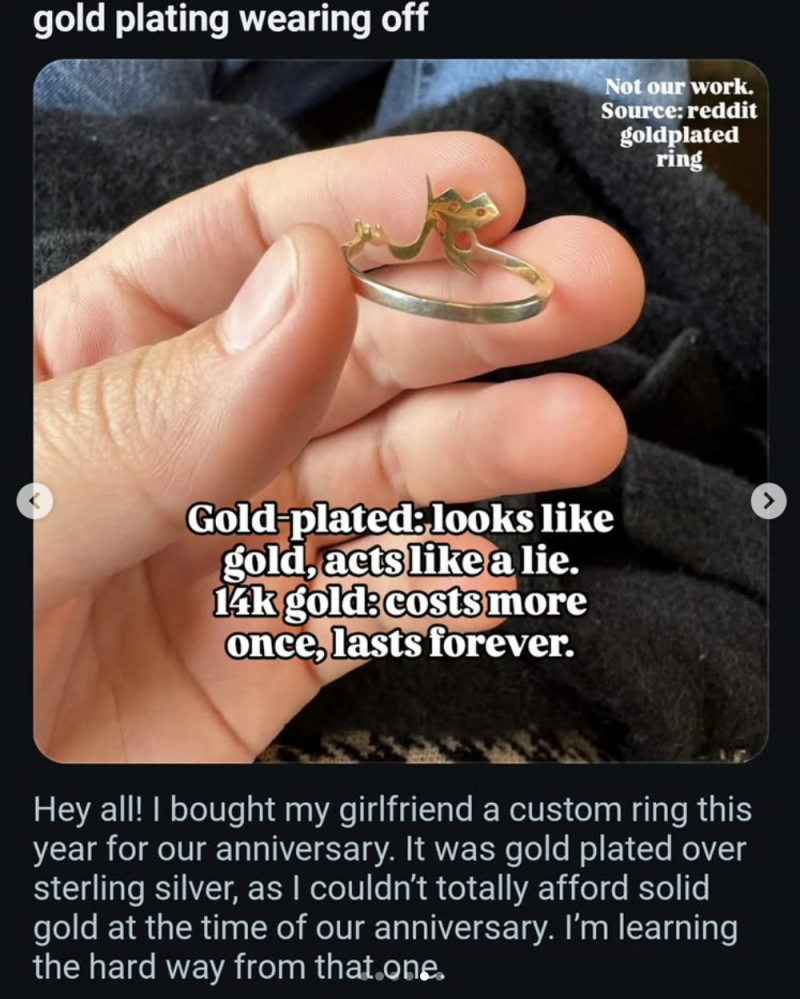
The back of a ring (the part you cannot see in a mirror but everyone else can) is the first to go. The gold film thins and then breaks open, and a dull yellow-brown or pink-orange color shows through. That's brass or copper saying hello.
A pendant on a chain looks fine from the front, but flip it over and the back has dulled. Spots appear where it sat against skin most often. If it's a piercing post, the part that goes through the lobe has worn first because that's the highest friction point.
Earring hooks dull at the curve. Bangles wear through where they touch your wrist bone. Chains lose color at every link contact point. Watches develop patchy backs.
And then, somewhere between six and eighteen months, the piece stops looking "gold" and starts looking like the cheap metal it always was, with some gold-colored memories. It is, at that point, almost impossible to fix. You cannot meaningfully repair plated jewelry. Re-plating is possible but it's a cost most people don't want to pay every year on something they thought of as "their gold piece."
So the math gets ugly. You spent €40, €80, €150 on a "gold" item that lasted a year. Multiply by however many of those you've bought in your life. Then look at the actual cost of one solid 14K creation made by hand and tell us which one was really cheaper.
Cheap is not a value. Cheap is not something you deserve. You deserve something that is worthy.
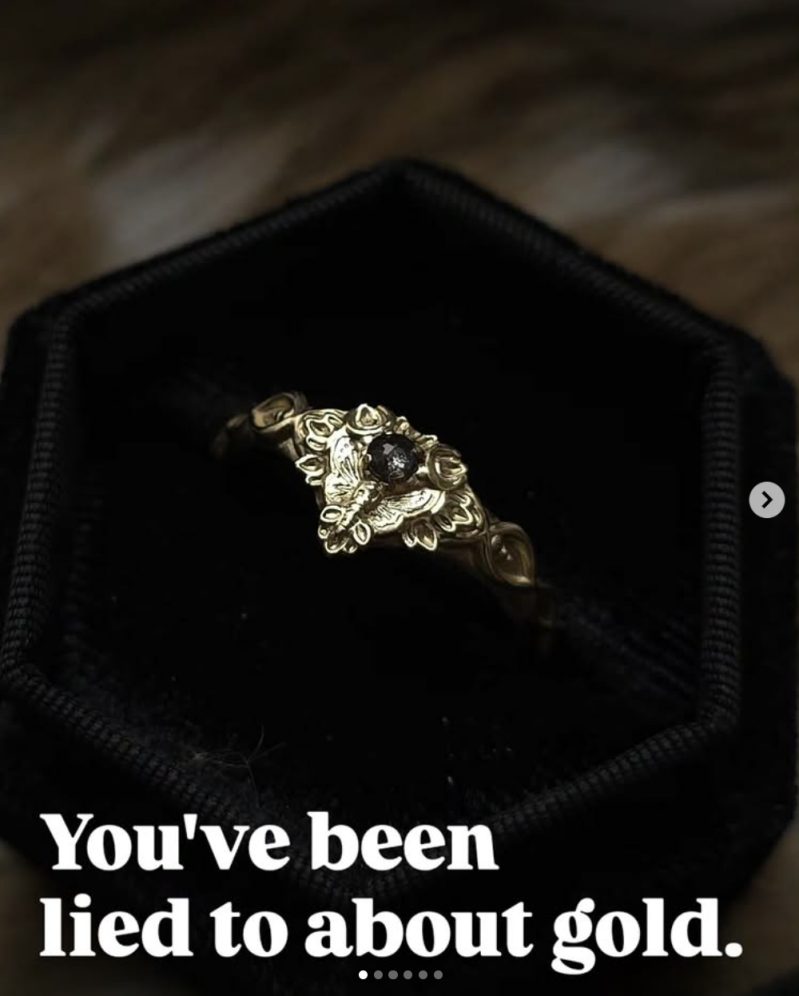
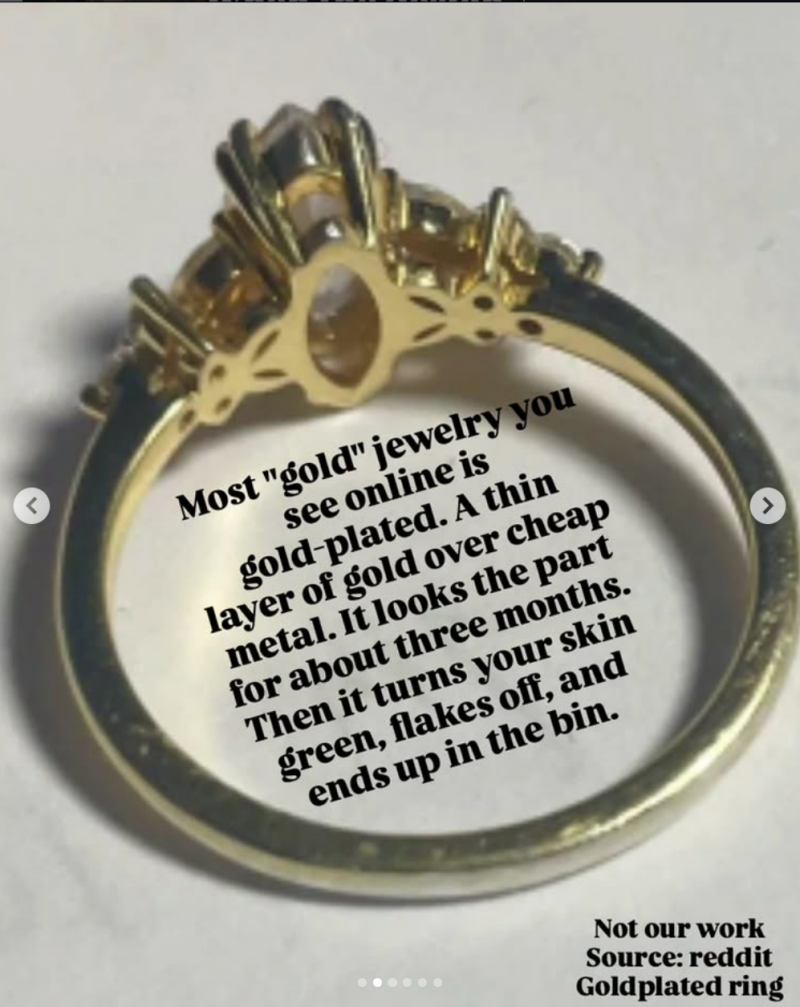
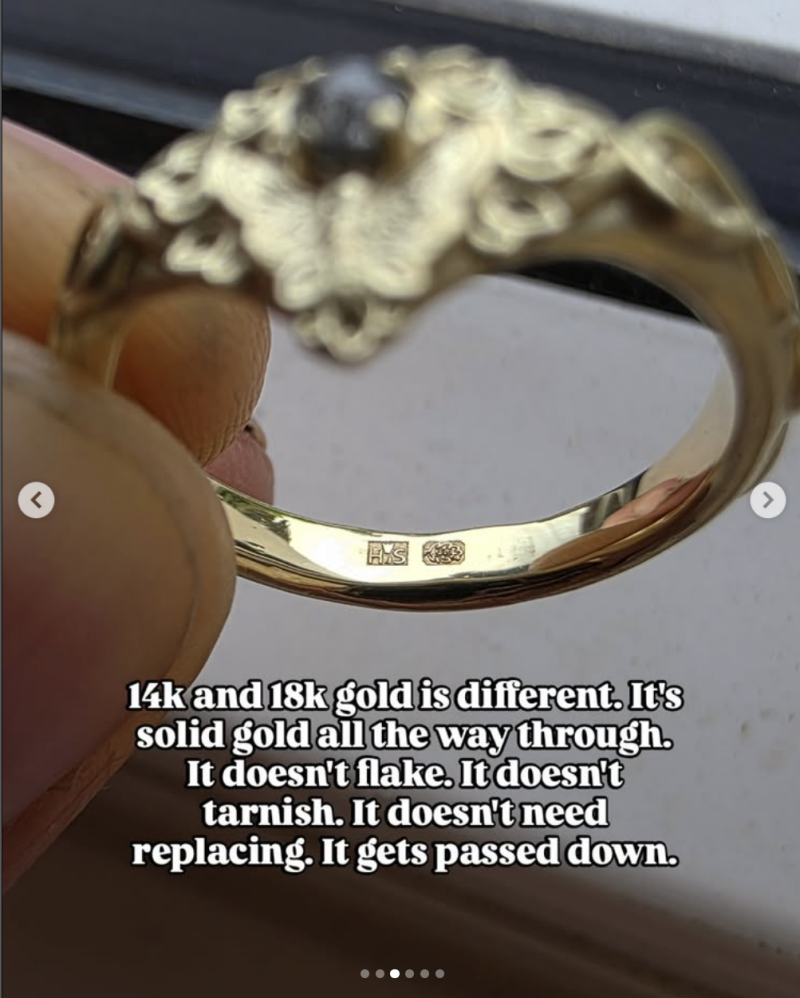
The vermeil and doublé cost trap
Here's the part that surprises people. Quality plating, at a thickness that actually lasts (closer to 5 microns or more), is not actually cheap.
If we were to plate one of our sterling silver creations with a proper, durable thickness of 14K or 18K gold (well above the US FTC minimum vermeil thickness, though still nowhere near the Dutch 50-micron threshold), the cost added to the piece would be roughly €350 on average. That's a real number from our side. And here's the cruel part: even at that price, the layer still has a finite skin-contact lifespan. Even premium plating wears at friction points.
So we sat down at our bench, did the math, and decided: we are not going to ask you to pay €350 extra for something that will eventually fail. It's not the kind of creation we want to put our name on. If you're paying that kind of money, your creation should last a lifetime, not five years.
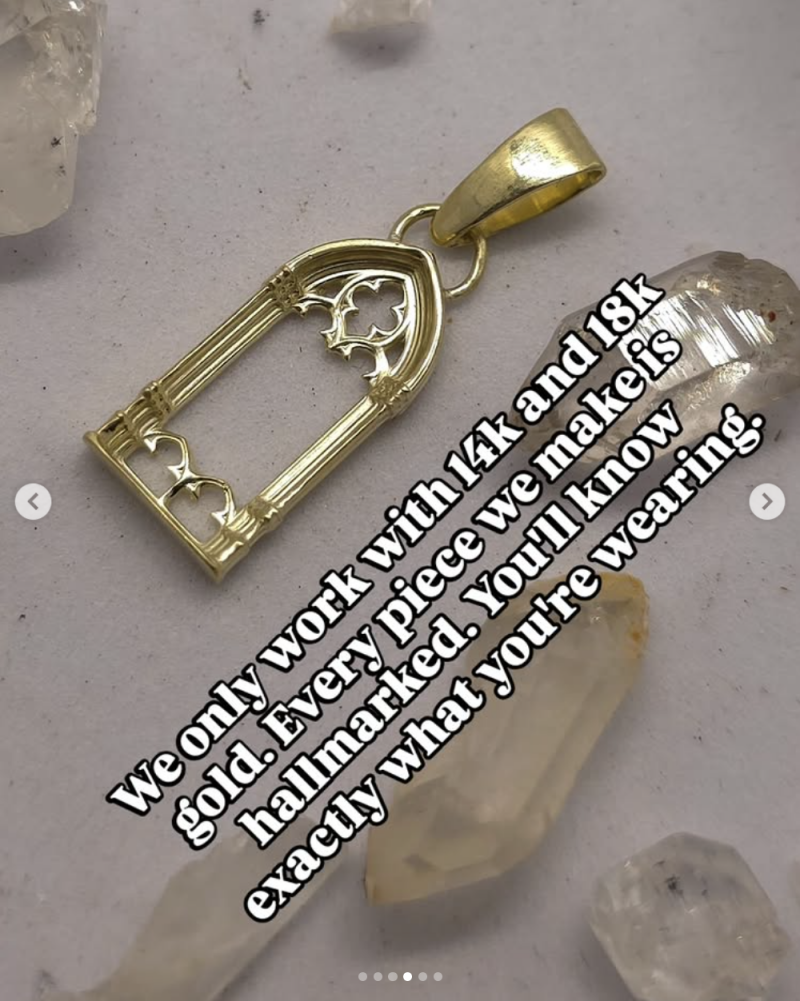
That decision is the whole reason we work in solid gold and sterling silver, full stop. No vermeil. No verguld. No doublé. No goldfilled. No hybrid maths. The metal you see is the metal all the way through.
How to tell what you're actually buying (read the hallmark)
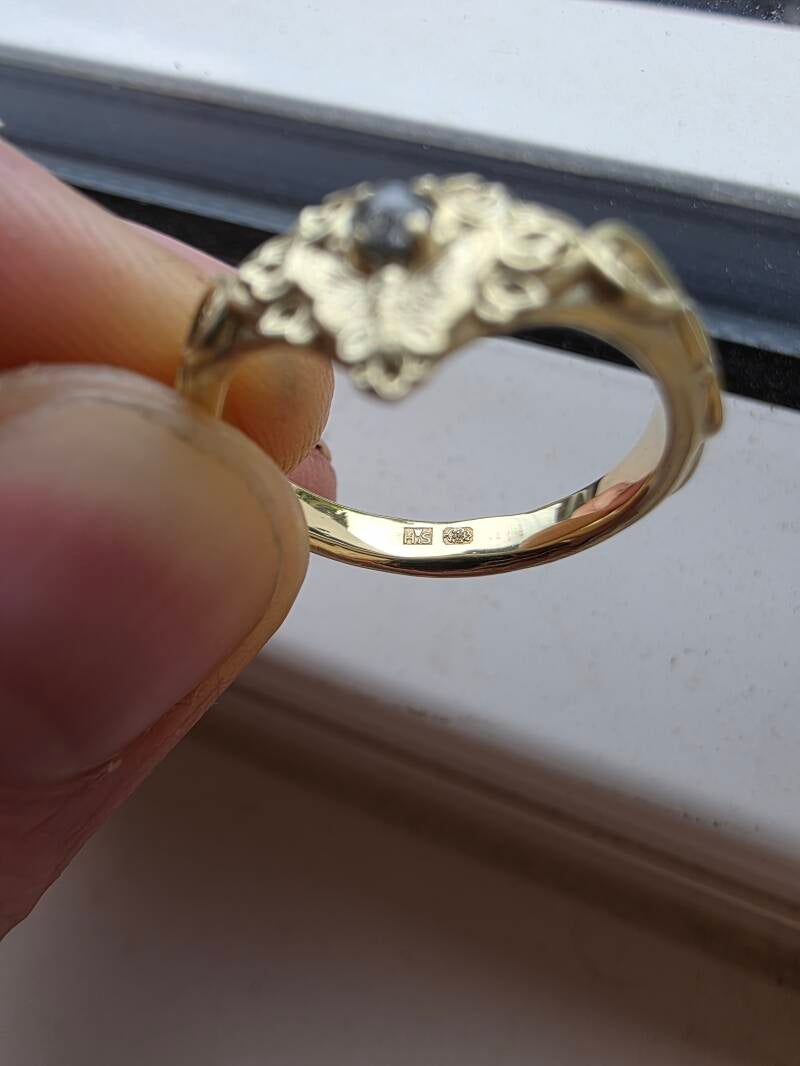
A genuine solid gold piece sold in the Netherlands will have a tiny official keurmerk stamp from WaarborgHolland (the lion mark with the karaat number) or EWN. Look inside ring shanks, on the tab of a chain clasp, or on the back of a pendant. You'll want a loupe (a small magnifier of at least 10x) to see them clearly.⁴
Solid gold marks you can trust in the Netherlands and EU:
- 585 or 14K = 14 karat solid gold (58.5% pure)
- 750 or 18K = 18 karat solid gold (75% pure)
- 375 = 9 karat (legal in some EU countries, but cannot be sold as "goud" in the Netherlands because it's below 585)
- 999 or 24K = 24 karat (essentially pure)
- 925 = sterling silver
Plus the official assay office mark of WaarborgHolland or EWN, and a sponsor's mark identifying the maker.
If you instead see:
- verguld, GP, GEP, HGE, HGP = gold plated (a coating under 50 microns)
- goldfilled, GF, 1/20 14K GF = gold filled (a coating under 50 microns, also a coating in Dutch law)
- doublé, RGP = mechanical plating (still a coating under 50 microns)
- vermeil = marketing term, treated as a coating under Dutch law
- PVD, IP coating = vapor-deposited coating, under 50 microns
If there is no stamp at all on a piece sold as "gold," especially one over 1 gram, that's a serious red flag. In the Netherlands it is actually illegal to sell unstamped gold above 1 gram as gold.⁴ No stamp, no proof, no compliance with the Waarborgwet 2019. You can report this kind of seller to RDI directly.²
So what do we make at Wolfstone?
Only the real stuff. Two materials, both solid, both honest:
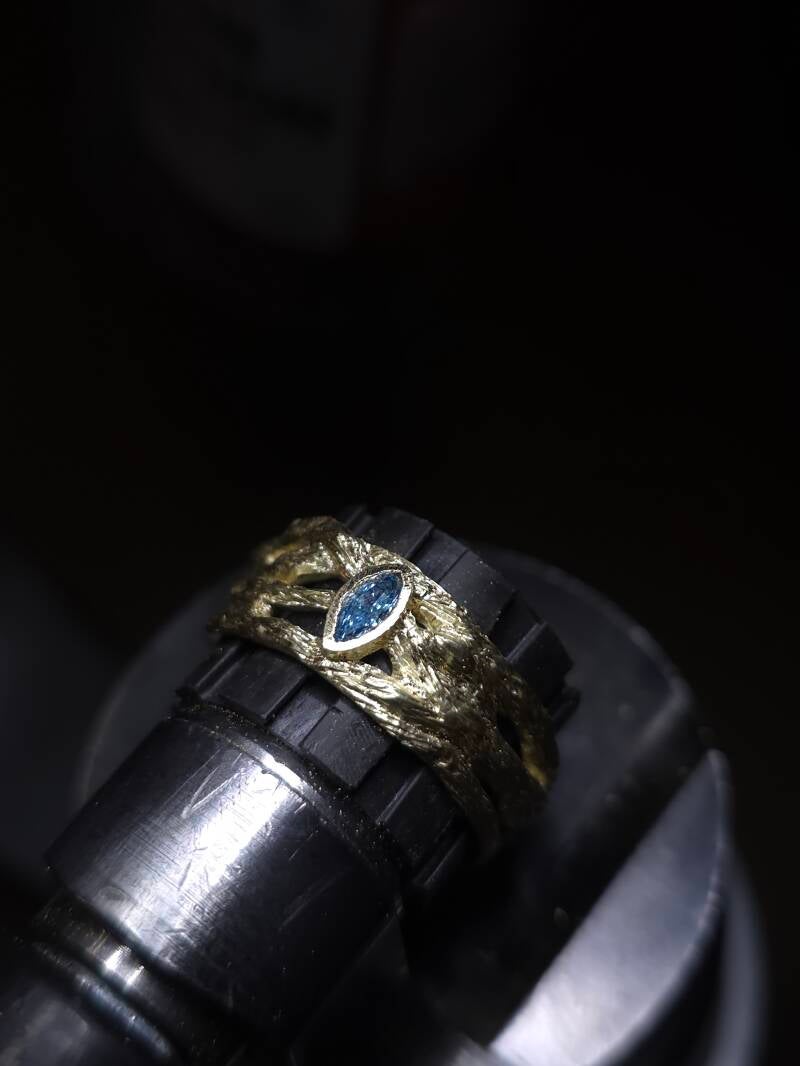
- Solid 14K gold (and 18K on request) for our Heirloom Vault Collection, our Fine & Precious creations. Handmade in our atelier with precious gemstones, diamonds, and gold inlay. Every gold piece above 1 gram goes through WaarborgHolland or EWN for proper Dutch hallmarking. Browse the Heirloom Vault here: atelierwolfstone.com/jewelry-realm/the-heirloom-vault-collection.
- Sterling silver (925) for everything else, openly and proudly. Silver is not a "lesser" version of gold to us. It's a beautiful metal in its own right, with its own honest place. We hallmark every silver creation above 8 grams too.
If the price of solid gold is the obstacle, please read our blog on recasting old gold in the Story Realm. Using gold you already own (a grandparent's wedding band, a piece you never wear, an inheritance in a drawer) is the genuinely smart, sustainable, beautiful route into a solid gold creation. We wrote the full process there.
If you want something built only for you, visit our Custom Realm.
-
One of a Kind

-
Made to Order
 The Cathedral Window Pendant | 14K gold | Made to Order | Regina €850.00 FREE shipping
 -
Made to Order
 The Drama Queen Ring | 14K Gold | Made to Order | personisable gemstone | Regina €1,750.00 FREE shipping
 -
One of A Kind
 The Drama Queen Ring | 14K Gold | size 17 | Ready to Send | Green Diamond | Regina €2,050.00 FREE shipping
 -
Made to Order
 Villain Era Rings | 14K Gold | Made to Order | Size Inclusive | Regina €995.00 FREE shipping
Quick answers (What you probably actually googled for)
Is gold plated real gold?
There is a small amount of real gold on the surface, yes. But the piece itself is not gold. Under the Dutch Waarborgwet 2019, any coating thinner than 50 micrometers cannot legally be sold as "goud" (gold). It is a coating, on a base metal core.³
What is the difference between solid gold, gold filled, vermeil, and gold plated in EU and Dutch law?
In the Netherlands, only solid gold (or hollow gold) of at least 14 karat (585/1000) can be sold as "goud" and receive a Dutch hallmark. Gold filled, vermeil, verguld, doublé, and gold plated are all legally grouped together as coatings under the Waarborgwet 2019, because they all have surface layers below 50 micrometers. The US FTC has separate categories (vermeil minimum 2.5 microns, gold filled 1/20th by weight), but those US standards do not change the Dutch legal classification.³⁻⁸
How long does gold plated jewelry last?
For standard fashion plating (often 0.175 to 0.5 microns thick), often only a few months to a year of daily wear before significant fading or wear-through at high-friction spots. Better-quality plating (5 microns and up) lasts longer but still has a finite skin-contact lifespan.⁹⁻¹⁰
Does solid gold tarnish?
No. Gold is a noble metal, chemically inert under normal conditions, and does not tarnish, rust, or corrode. Silver tarnishes by forming silver sulfide on the surface when exposed to sulfur compounds in the air, but solid 14K and 18K gold do not.
Does gold plated jewelry turn skin green?
Often, yes. Once the gold layer wears through to the base metal (typically brass or copper), the copper in that base metal reacts with sweat and skin oils to form copper salts, which deposit on skin as a green or greenish-black stain. This does not happen with solid gold.
Is vermeil worth it?
It depends on what you're comparing it to. Quality vermeil looks beautiful when new and lasts longer than thin fashion plating. But under Dutch and most EU law, vermeil is not a recognised separate category. It's classified as a coating. And even quality vermeil from a real goldsmith costs significantly more than people expect (often around €350 added to a sterling silver creation). For that money, many people would be better served either staying with solid sterling silver or saving toward a solid gold creation that lasts a lifetime.
What does verguld, doublé, GP, GEP, GF, or RGP mean on jewelry?
They are all coating markings, not solid gold. Verguld is the Dutch word for "gold plated." Doublé is a thicker mechanical plating but still a coating under 50 microns. GP, GEP are gold electroplated. GF is gold filled. RGP is rolled gold plate. Under the Waarborgwet 2019 all of these are coatings, not gold.³
How can I tell if my gold is real in the Netherlands?
Look for an official keurmerk (hallmark) from one of the two Dutch assay offices, WaarborgHolland or Edelmetaal Waarborg Nederland (EWN), plus a karat number (585 for 14K, 750 for 18K). A piece sold as gold above 1 gram without a Dutch hallmark is illegal under the Waarborgwet 2019. You can report suspected violations to the RDI.²
Who enforces the Dutch gold law?
The Rijksinspectie Digitale Infrastructuur (RDI), a national inspectorate of the Ministry of Economic Affairs (formerly Agentschap Telecom, renamed 1 January 2023). RDI inspectors visit jewelers, wholesalers, market stalls and online sellers unannounced.²
When you're ready for a creation that's gold all the way through, properly hallmarked, and built to outlive you, we're right here. ♡
Kaat & Huib Atelier Wolfstone, two self-taught goldsmiths who create for the beautifully unconventional
Sources
¹ Waarborgwet 2019. Dutch hallmarking law, effective 1 July 2020, replacing the Waarborgwet 1986. Aims: protect consumers against falsification of precious metal content, and enable consumers to trust that the metal in a piece matches the stated fineness. waarborg.nl/waarborgwet.
² Rijksinspectie Digitale Infrastructuur (RDI). Dutch government inspectorate under the Ministry of Economic Affairs, formerly Agentschap Telecom (renamed 1 January 2023), responsible for enforcement of the Waarborgwet. Inspectors visit jewelers and sellers unannounced and accept consumer reports of violations. rdi.nl/onderwerpen/consumenten/goud-zilver-of-platina.
³ RDI, Leidraad toegestaan woordgebruik bij verkoop edelmetalen (Guide to permitted language for selling precious metals). Official RDI brochure issued 10 May 2023, based on Article 33 of the Waarborgwet 2019. Specifies that surface layers of less than 50 micrometers (categorised as: verguld, goldplated, goldfilled, doublé, mesh, PVD/IP/RGP/HGE coating, goudkleurig) are not assayed and cannot legally be sold as "goud." rdi.nl/documenten/brochures/2022/07/18/toegestaan-woordgebruik-edelmetalen.
⁴ WaarborgHolland and Federatie Goud & Zilver. Hallmarking thresholds in the Netherlands: gold from 1 gram, silver from 8 grams, platinum from 0.5 gram. Minimum legal fineness to be called "goud": 585/1000 (14K). waarborg.nl, fgz.nl/waarborgwet.
⁵ Edelmetaal Waarborg Nederland (EWN). One of the two Dutch assay offices appointed under the Waarborgwet 2019. Accredited by the Raad voor Accreditatie under ISO/IEC 17020 (inspection bodies) and ISO/IEC 17025 (testing laboratories). ewnederland.nl.
⁶ Waarborgwet 2019, articles 3 and 5. Set out the rules for assaying composite items (samengestelde voorwerpen) and surface layers. The 50-micrometer threshold for assayed surface layers is detailed in the implementing rules and the RDI guide cited above.
⁷ Convention on the Control and Marking of Articles of Precious Metals (the Hallmarking Convention or Vienna Convention, 1972). International convention to which the Netherlands and most major European jewelry-producing countries are signatories, providing mutual recognition of national hallmarks (the Common Control Mark, CCM) across contracting states. hallmarkingconvention.org.
⁸ US Federal Trade Commission, 16 CFR Part 23, Guides for the Jewelry, Precious Metals, and Pewter Industries. Cited here for international context only. Sets US standards: vermeil = minimum 2.5 micrometers of at least 10K gold electroplated over sterling silver; gold filled = minimum 1/20th (5%) of total weight in 10K+ gold mechanically bonded to base metal. These US standards are substantially less strict than the 50-micrometer Dutch threshold under the Waarborgwet 2019. law.cornell.edu/cfr/text/16/part-23.
⁹ Chemistry LibreTexts, Electroplating. Academic chemistry reference explaining electroplating as an electrochemical deposition process and noting that decorative finishes commonly use a thin layer of gold or silver applied for visual appeal rather than long-term durability. chem.libretexts.org.
¹⁰ ProPlate (industrial plating engineering reference). Industrial plating engineering source documenting that wear and mechanical damage to electroplated surfaces weakens the bond between the plated layer and the substrate, allowing corrosion of the base metal once the layer is compromised. proplate.com.
¹¹ EU Regulation (EC) No 1907/2006 (REACH), Annex XVII, Entry 27. Restrictions on nickel migration in jewelry intended for direct and prolonged skin contact (less than 0.5 µg/cm² per week) and post assemblies for pierced parts of the body (less than 0.2 µg/cm² per week). Test method: EN 1811:2023. Nickel sensitization rate of roughly 10% in the general population of Western Europe and North America is documented by the Nickel Institute and the EU's scientific assessments underlying the REACH restriction.
Add comment
Comments